You Good, Man? Yeah? You a Veteran?
Hey, veterans.
Yeah, you.
The one limping across the parking lot every morning like that’s just how you walk now.
The one working your ass off at the job you got after you left the military, trying to pay the bills, take care of your family, and figure out what the hell you’re supposed to be doing with the rest of your life.
The one who hasn’t slept right in years.
The one whose back hurts, knees are shot, ears ring, temper is shorter than you’d like to admit, and who still answers, “I’m good,” when somebody asks how you’re doing.
The one who says:
Other guys had it worse.
I wasn’t blown up.
I can still work.
It wasn’t that bad.
I signed up for this.
I want to talk to you.
You got really good at carrying shit.
Somewhere between the 19-year-old kid who raised his right hand because he wanted to serve his country, see the world, pay for school, get the hell out of his hometown, or just figure out what came next…
…and the 45-year-old man whose body feels 20 years older than it is, something happened.
Maybe it wasn’t one catastrophic thing.
Maybe it was thousands of smaller things.
The miles. The weight. The shitty sleep. The injuries you didn’t report. The stuff you saw. The things you did. The people you lost. The constant go. The years of ignoring pain because everybody around you was ignoring theirs too.
And now, you’re looking at the aftermath and telling yourself:
It wasn’t that bad.
I’ve met so many men who carry it all.
And they carry it well.
At least from the outside.
You work. You provide. You take care of your family. You help your buddies. You fix shit. You show up when someone needs you. You’re dependable. Capable. You’re the person everybody knows they can call when something needs to get done.
Maybe you’re not just functioning.
Maybe you’re overfunctioning.
Because somewhere along the way, carrying it well became evidence that you weren’t carrying anything at all.
But functioning and being okay aren’t the same thing.
Sometimes the people carrying the most are the ones who’ve gotten the best at making it look like it isn’t heavy.
I know something about carrying bags.
To this day, one of my favorite pieces of artwork is a piece by Herbert C. Bailey called the “Last Bag Drag.” Not because it’s some badass deployment image.
But because, to me, it represents something much bigger.
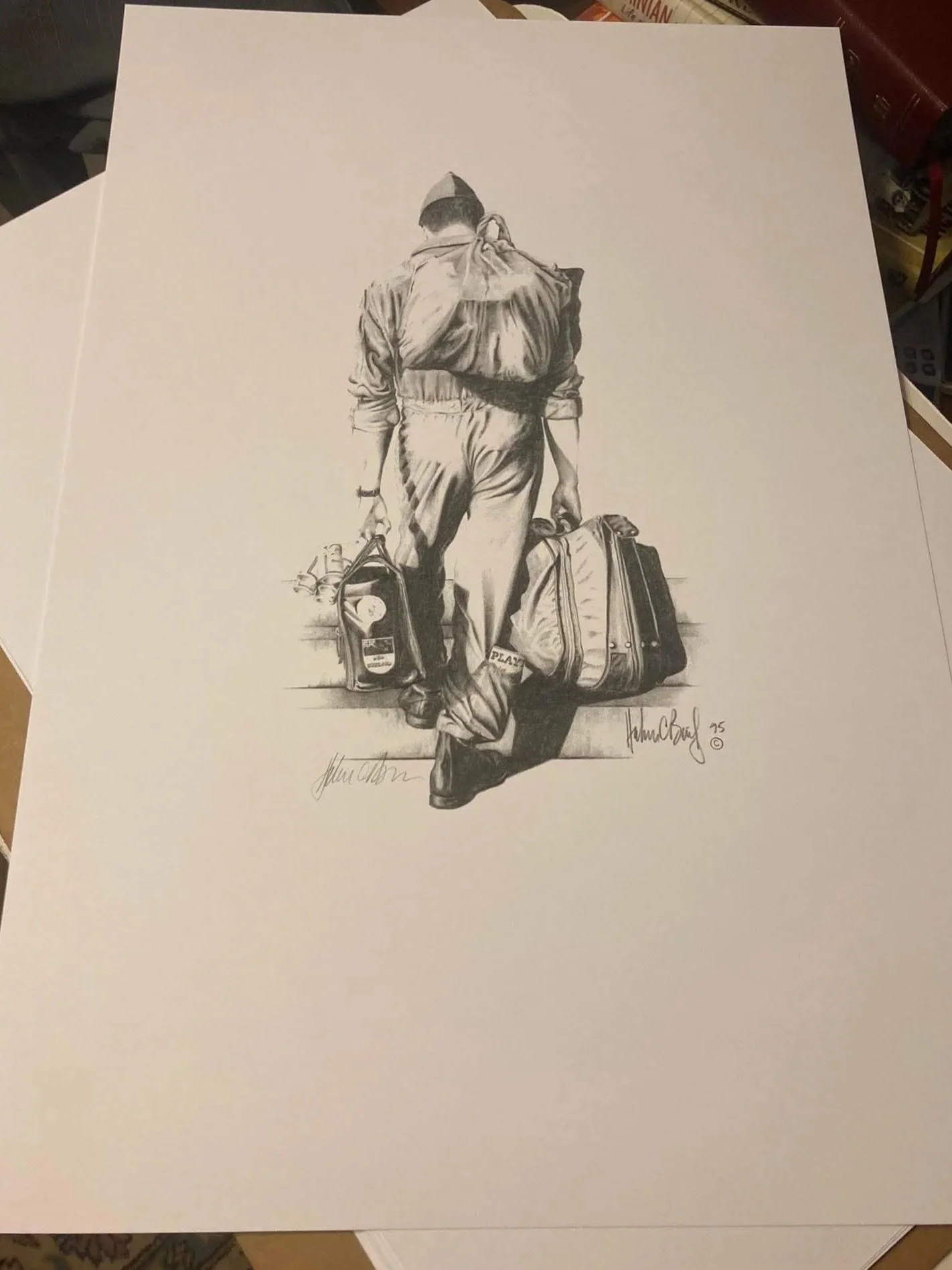
“Last Bag Drag”
Artwork shared with permission
We carried shit.
Literally, obviously.
I was aircrew. And before you judge me for being a “zipper-suited sun goddess,” hear me out.
You grab your bags. You shoulder the weight. You go where you’re supposed to go. You don’t stand around discussing whether it’s too heavy. You don’t ask whether somebody else should carry it for you.
You pick up your shit and move.
Your version of the bag drag might have looked very different from mine, but I think a whole lot of us learned the same lesson:
Carry your shit. Don’t complain. Keep moving.
That mentality can get you through a mission.
It can also follow you home.
And maybe some of us never really stopped carrying the bags.
“But I signed up for this.”
Yeah.
You did.
You knew military service was going to ask things of your body. Of your mind.
Early mornings. Rucks. Running. Jumping. Carrying shit that was too heavy. Terrible sleep. Deployments. Training. Injuries you worked through because everybody worked through them.
Maybe combat. Maybe trauma.
Maybe nothing that you consider particularly remarkable.
But, “I signed up for this” is not the same thing as “I agreed to deal with the consequences alone for the rest of my life.”
Just because somebody else had it worse doesn’t mean your service didn’t cost you something.
Your buddy losing a limb, or their life, doesn’t make your knee hurt less.
Someone else’s PTSD doesn’t make your nightmares irrelevant.
Another veteran receiving more disability compensation doesn’t mean you aren’t deserving of compensation for legitimate conditions connected to your service.
This isn’t the suffering olympics.
The systems that exist to provide medical care, mental health treatment, and compensation after military service exist for a reason. Military service can have lasting consequences.
Use the systems that are there.
You don’t have to prove that you’re more broken than somebody else before you’re allowed to get help.
And we need to talk about what the military taught you about asking for help.
The military loves to tell you to take care of yourself.
Go to medical.
Talk to mental health.
Ask for help when you need it.
Take care of your people.
And then, depending on when you served, your job, your unit, and your leadership, you may have learned a very different lesson about what happens when you actually do.
Maybe you were treated differently,.
Maybe somebody questioned whether you could still do your job.
Maybe you watched it happen to somebody else and learned from their mistake.
Maybe you learned really damn quickly what you could document and what you were supposed to shut the fuck up about.
So you did.
And maybe that served you then.
I tell my clients all the time that the things we learn to do to survive aren’t inherently good or bad.
They served us for a season.
The problem comes when the season changes and the strategy doesn’t. You wouldn’t go from a combat zone in Iraq to one in Vietnam and expect the same strategy to work. The same applies as we move through life.
Keeping your mouth shut may have served you.
Compartmentalizing may have served you.
Pushing through pain may have served you.
Staying hyperaware, shutting off emotion, handling everything yourself, and never letting anybody see you struggle may have helped you do your job, protect yourself, or protect the people around you.
And if we’re being really real, you may have learned some of those things long before you ever put on a uniform.
Maybe the military didn’t teach you how to shut down, stay on guard, take care of everybody else, or handle shit yourself.
Maybe it just gave those skills somewhere to thrive.
That doesn’t mean you have to live the rest of your life that way.
If nobody has told you this yet:
You don’t have to hide it anymore.
You don’t have to minimize what’s happening to your body. You don’t have to make a joke out of everything that happened. You don’t have to tell everyone you’re good when you’re very much not good.
And if someone in your life today still requires you to pretend you’re fine in order for them to be comfortable with you?
It might be worth taking a hard look at that relationship.
“Hunting is my therapy.”
I hear this one a lot.
And listen, I get it. I hunt too. Some of the best worst times of my life have happened in the woods.
There’s something about being completely absorbed in what’s happening around you.
Watching the wind. Listening for movement. Noticing tracks. Looking for an ear flick or the tiniest change in the landscape. For once, your attention is right here instead of seventeen steps ahead.
And there’s actual research behind why being outside can feel so damn good. Nature exposure has been associated with reductions in perceived and physiological stress, and research on nature-based activities has found improvements in anxiety, mood, and other mental health outcomes.
So yes.
Hunting can absolutely be therapeutic.
So can fishing. The gym. Hiking. Working in the garage. Riding your motorcycle. Being outside. Spending time with your buddies.
Please keep doing the things that make you feel like yourself.
But therapeutic and therapy aren’t the same thing
Unfortunately, getting out of the military isn’t going to erase the things you’ve experienced.
And neither is sitting in the woods.
The woods can give you space. They can quiet some of the noise. They can give your nervous system something different to pay attention to. They can remind you that you’re capable, connected, and alive.
But they can’t do the work for you.
And some of what you’re carrying may have started long before you ever put the uniform on.
So hunt. Fish. Hike. Lift. Build shit in your garage. Spend time with your buddies.
Do the things that make you feel like yourself.
And then take care of the things those things can’t fix.
You don’t have to give up who you are to heal.
You don’t have to stop being tough.
You don’t have to stop being the guy people can depend on.
You don’t have to give up hunting, dark humor, independence, competence, or your ability to handle hard shit.
And you aren’t going to lose your masculinity because you went to therapy, filed a VA claim, admitted something hurts, or finally told somebody you’re not doing as well as you’ve been pretending.
You don’t have to give up the parts of yourself you like in order to heal.
The goal isn’t to erase what happened. It isn’t to pretend it didn’t affect you. And it isn’t to turn you into somebody you don’t recognize.
It’s figuring out what you still need to carry, what you can finally put down, and what you want the rest of your life to look like.
Strength isn’t pretending nothing hurts.
Sometimes strength is finally deciding you don’t need to keep hurting just to prove you can handle it.
I’ve seen what happens when you start putting some of it down.
I’ve sat across from men who spent years carrying it all.
Men who didn’t think what happened to them was “bad enough.” Men who weren’t sure therapy was for them. Men who were much more comfortable talking about what needed to get done than talking about what was happening inside of them.
And I’ve watched things change.
I’ve watched men start sleeping better. Start understanding why they’re so damn angry all the time. Catch themselves before shutting down or blowing up. Become more present with their spouse and their kids. Stop picking up a drink to numb the pain. Start recognizing what’s happening in their bodies instead of ignoring it until their system is screaming at them.
I’ve watched men realize that some of the things they thought were just who they are were actually ways they’d learned to survive.
And no, therapy didn’t erase what happened to them.
They didn’t become different men. They became men who had more choices. Who understood themselves and their experiences better.
They could still be strong. Still be capable. Still have the dark humor. Still hunt and fish, work with their hands, take care of their families, and be the guy people could count on.
They just didn’t have to white-knuckle their way through every damn thing anymore.
And that’s part of why I’m writing this.
I’m sitting here on the side of a mountain, in one of my favorite places to be, waiting on an elk, seeing nothing but deer, and thinking about all the other military and veteran hunters sitting on mountains, in tree stands, or tucked into blinds somewhere.
And I’m wondering how many of you are sitting out there carrying shit nobody knows you’re carrying.
How many of you come out here because it’s one of the few places your brain gets quiet.
How many of you feel more like yourself out here than you do anywhere else.
How many of you will pack up your gear, go home, go back to work, take care of your family, help everybody else with their crap, and keep telling yourself that yours isn’t bad enough to do anything about.
I’ve worked with enough of you to know that it can feel different.
I’ve watched men get pieces of their lives back that they didn’t even realize they had lost.
And maybe you’ve been living this way for so long that you genuinely don’t know it could feel different.
It can.
You don’t have to stop hunting. You don’t have to stop being tough. You don’t have to become somebody else.
But maybe while you’re sitting out there waiting for something to walk through, you can ask yourself one question:
What am I still carrying that I don’t have to carry anymore?
You don’t have to fix everything today.
I know it’s overwhelming.
Especially when you’ve ignored something for five, ten, twenty, or thirty years.
So don’t fix all of it today.
Make the appointment you’ve been putting off.
Ask somebody how to start the claim.
Tell your doctor about the knee you’ve been pretending doesn’t hurt.
Call the buddy you’ve been avoiding.
Tell your spouse you’re actually not doing that great.
Find a therapist.
And if the first therapist isn’t your person, find another one.
Pick one damn bag.
You don’t have to unload everything today.
But you also don’t have to carry every dang bag forever.
And ladies…
If you’re reading this thinking, man, you just described my husband, I see you too.
Maybe you’ve spent years watching a man you love carry everything while insisting he’s fine.
You can encourage him. You can remind him that getting help doesn’t make him weak. You can sit beside him while he makes the call or figures out where to start.
But you cannot do the work for him.
And you don’t have to destroy yourself trying to keep someone else afloat while they refuse to acknowledge they’re drowning.
And to my fellow women veterans who made it this far thinking, Okay, but you just described me too…
Yeah.
I know.
Military culture didn’t reserve overfunctioning, minimizing, trauma, and carrying too damn much for the men.
This one was written specifically for them, but the invitation applies to you too.
Go take care of your damn self.
You served.
Maybe you’re proud as hell of that. I hope there are pieces you wouldn’t trade for anything.
This isn’t about hating the military. It isn’t about deciding everything it taught you was wrong. And it isn’t about turning you into someone else.
It’s about recognizing that some of the things that helped you survive one season of your life may not be serving you in this one.
You don’t have to wait until you can’t work.
You don’t have to wait until drinking becomes “a problem,” until somebody else calls it a problem, or until you get a DUI and can’t pretend it’s fine anymore.
You don’t have to wait until the pain is unbearable.
You don’t have to wait until you’re completely broken before you decide you’re allowed to take care of yourself.
And you sure as hell don’t need to earn care by getting worse first.
You’ve carried enough.
Go take care of your damn self.
